Projects / No. 01
Bagels
Refining my bagel-making craft one batch at a time.
- Type
- Project
- Year
- 2026
- Skills
- Yeast, flour, making friends, toroidal baking
What is a bagel?
Long ago, humans fought over land, food, water, and religion. Today, with modern technology and a great enlightenment or two behind us, we have evolved. Not only do we still fight over all those lame old causes, now we also fight over new, fun, and pedantic causes like what constitutes a good bagel. A good bagel is large, has a robust and chewy crust, a soft and slightly elastic interior, and a decently light crumb. This is what I have been targeting in my bagel journey, and this is what all bagel shops in humanity should be targeting as they look to me as the true and righteous arbiter of all that shall concern a bagel.
How's progress?
Many bagels have been made (about 100 to date by me, I assume a few trillion by others). My bagel journey began with this recipe because the author seems to agree with my idea of a good bagel and recognizes the simple and elegant beauty of the Computer Modern typeface. It is safe to say that users of the Computer Modern typeface are among the most worthy and upright members of our society, so I trusted this author to be a helpful guide in this bagel expedition. This turned out to be a good call.
I have made six bagel boards to bake my bagels on. If you are unfamiliar, a bagel board is a board with a burlap or canvas wrap that gets soaked in water and then is used to load the bagels into the oven. These boards originated from commercial shops that would need to flip 40+ bagels at a time; however, home bakers found that the bagel boards are necessary to create the steamy environment that adds spring to the bagel and deepens the crust. I have copied these home bakers who have copied the bagel shops, and feel that these boards are important to the process.
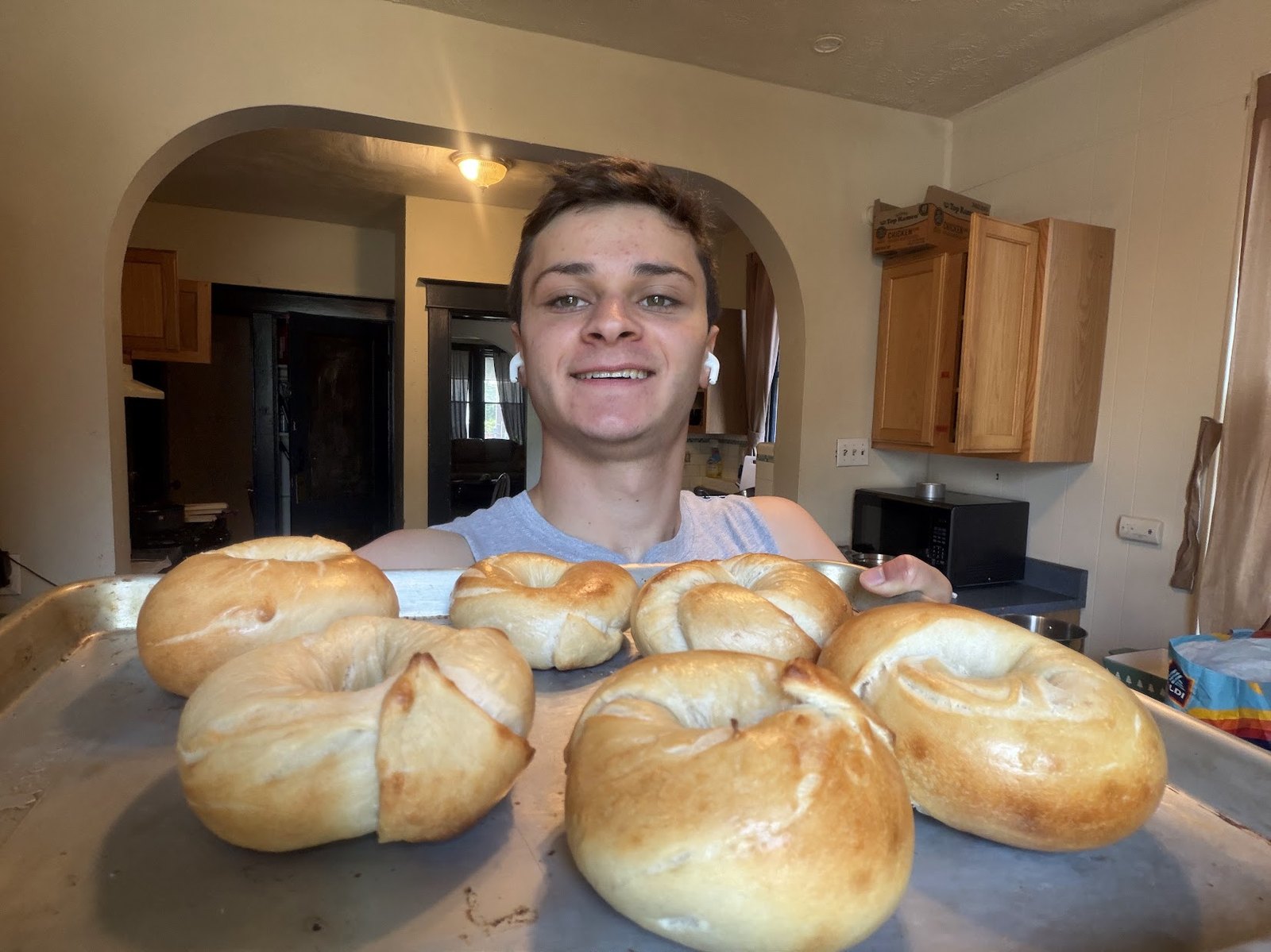
Over the five iterations of the bagel, three have been adequate, one has been good, and the first was poisonous (nonstick pans lose nonstick coating above 425°F, resulting in nonstick shiny bagels). For some perspective on these qualitative descriptions, I [the true and righteous arbiter of all that shall concern a bagel] would say Pigeon Bagels in Pittsburgh is adequate, and the bagels back home in NJ are excellent. So far, my bagels have decayed much faster than commercial bagels, losing about half their quality within six hours of baking (compared to one or two days for bagels made in a shop). This will not be a concern once I am making truly excellent bagels, as they will not last six hours before being eaten.
What's Next
More bagels, of course! My most important objective is to perfect the proofing process. All the bagels I have made have had a tighter crumb than I would like, with the worst of the adequate batches being generally underworked and underproofed. The other reason to focus on this is that it is much more difficult and precise than the baking or the boiling. Baking and boiling are still not optimized, but they are easier to fix than proofing. I can also experiment several times within a batch in a way that is not easy to do in the 16-hour proofing process.
Stay tuned on this journey. Once I am pleased enough with my bagels, I will be posting a recipe and distributing bagels to nearby mouths.